
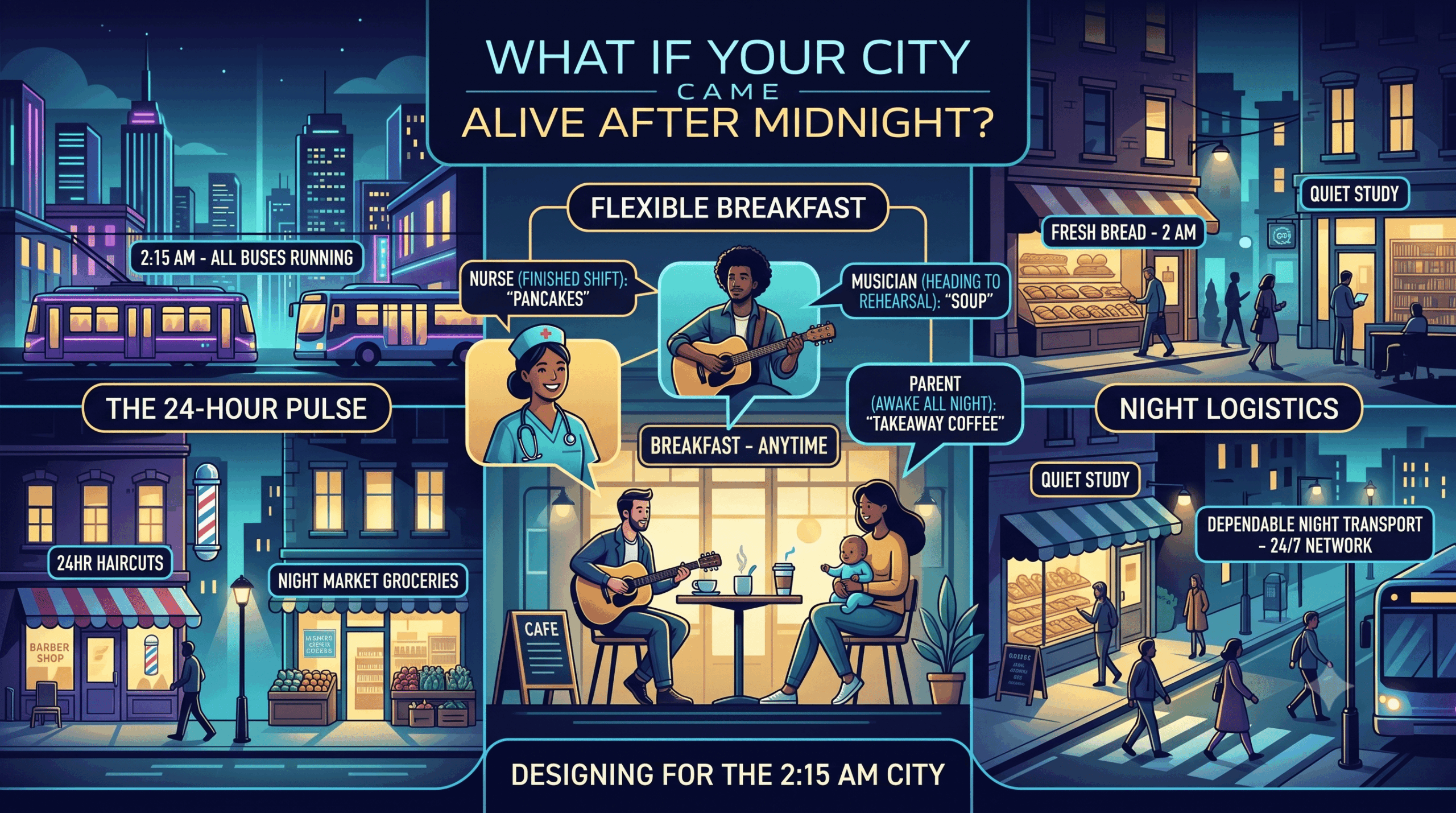
It is 2:15 a.m., and you have just finished work.
You need groceries, a haircut, and somewhere to sit down for a proper meal. In this imaginary city, all three are available within walking distance. The bakery is taking its first trays out of the oven. The library has a few empty seats. Your bus arrives in six minutes.
Welcome to a city designed for people whose days begin when other people’s days end.
Building it would take more than keeping a few shops open late. Transport, public spaces, housing, and work would all need to fit together. And one difficult question would shape every decision: how do you give half the city an active night while letting the other half sleep?
Breakfast would become a flexible idea
At the corner café, a nurse finishing her shift orders pancakes. A musician heading to a rehearsal wants soup. A parent who has been awake with a baby comes in for takeaway coffee.
The menu has no breakfast deadline.
Food businesses could serve smaller menus across different shifts, with each kitchen choosing hours that suit its neighborhood. A market near a hospital might be busiest before sunrise. Another beside offices could close shortly after dinner.
The interesting change would be the disappearance of the assumption that everyone gets hungry on the same schedule.
Ordering an omelet at midnight would require no explanation.
Getting home would matter as much as going out
A restaurant can stay open all night and still be difficult to visit if the last train leaves at eleven.
In our imagined city, overnight transport would be part of the basic design. A smaller network of dependable routes would connect homes with hospitals, workplaces, and late-opening districts.
Stations would have staff, clear signs, and sheltered places to wait. Timetables would account for shift changes.
For someone finishing work at three in the morning, the most useful feature might be wonderfully ordinary: knowing exactly how to get home.
The library would have a night shift
Nightlife usually brings particular images to mind: loud music, crowded bars, queues outside clubs.
But what about people who want to go somewhere quiet?
Picture a library at one in the morning. A student is revising at a large desk. Someone is reading a newspaper. Two friends are playing chess beneath a lamp.
Elsewhere, a swimming pool offers late sessions, and a community workshop opens for evening classes. There are places to spend time without buying alcohol or committing to an expensive night out.
Darkness would no longer narrow the city’s social life to a handful of activities.
The hardest design problem would be noise
Now imagine living above that popular midnight café.
The chairs scrape. Delivery vehicles arrive. Customers gather outside your bedroom window to finish conversations.
A successful overnight district would need careful boundaries. Loading areas could face away from homes. Buildings could use enclosed entrances. Outdoor seating might close before indoor service ends.
Some streets would remain deliberately quiet.
Residents would need a meaningful say in where late activity belongs. Otherwise, the convenience enjoyed by one group would become a nightly disturbance for another.
Someone would still have to work those hours
Behind every open door is a person.
An appealing vision of midnight shopping becomes less appealing if it depends on exhausted workers who have no choice about their shifts.
This city would need predictable schedules, adequate staffing, proper breaks, and realistic ways for employees to travel home. Businesses would also have to decide whether overnight demand justified opening at all.
Some would close. That would be fine.
The goal would be a useful range of services across the night, with enough people available to run them well.
At 4:40 a.m., you finally head home. A few passengers board your bus. Through the window, you see the librarian pulling down a blind and a baker stepping outside for a break.
Your day is ending. Theirs is somewhere in the middle.
The city has room for both.