
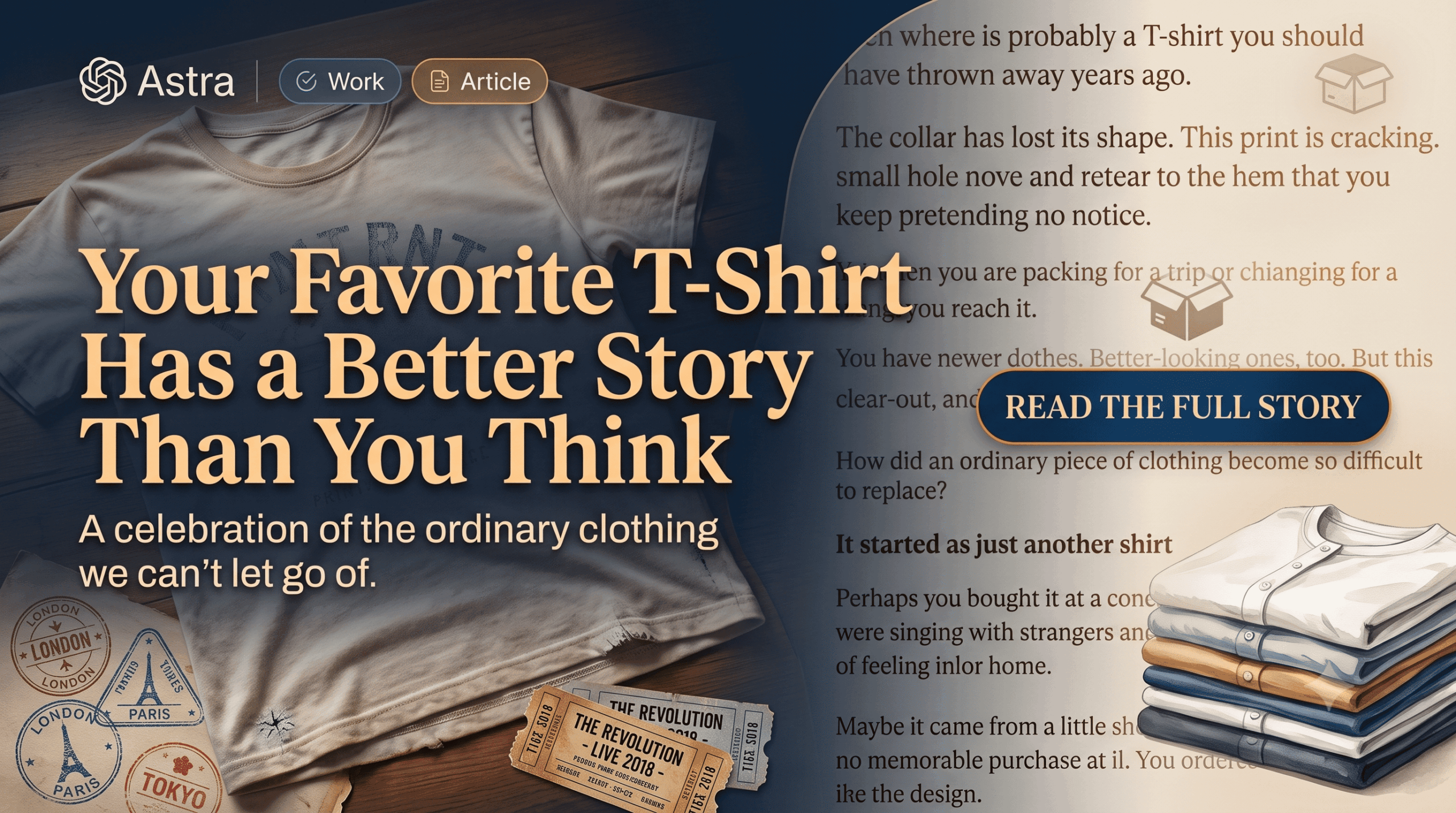
Somewhere in your wardrobe, there is probably a T-shirt you should have thrown away years ago.
The collar has lost its shape. The print is beginning to crack. There may be a small hole near the hem that you keep pretending not to notice.
Yet when you are packing for a trip or changing after a long day, you reach for it.
You have newer clothes. Better-looking ones, too. But this particular shirt has survived every wardrobe clear-out, and you already know it will survive the next.
How did an ordinary piece of clothing become so difficult to replace?
It started as just another shirt
Perhaps you bought it at a concert. At the time, the price seemed ridiculous, but you had spent two hours singing with strangers and wanted to take some of that feeling home.
Maybe it came from a little shop you found while escaping the rain on holiday. Or perhaps there was no memorable purchase at all. You ordered it online because you liked the design.
Then you wore it.
You wore it to breakfast, to the supermarket, on a long drive with someone who insisted they knew a shortcut. It appeared in photographs you forgot were being taken. It spent a weekend at a friend’s house and eventually came home in a borrowed bag.
Slowly, the shirt became part of the background of your life.
The design did some of the talking
A graphic T-shirt can introduce you before you say a word.
Someone spots the name of a band and asks which album you like. A stranger laughs at the tiny illustration above the pocket. A person across the room recognizes a reference that everyone else has missed.
For a moment, you have something in common.
That is part of the fun of choosing a design. You get to show a little of your taste without explaining your entire personality. A strange cartoon, an old film title, or a place you love can be enough.
Sometimes the most satisfying designs are the ones only a few people understand. When someone finally notices, it feels like discovering you have been sharing a private joke.
Then it became yours in a different way
Clothing changes with use.
The fabric softens. A sleeve develops a familiar fold. The print fades unevenly, and the shirt begins to look different from every identical one that left the shop.
Eventually, even a brand-new replacement would feel slightly wrong.
You know how this one sits on your shoulders. You know which jacket works with it. You can pull it from a drawer without thinking about whether you will feel comfortable wearing it.
There is a practical kind of affection in that familiarity. Getting dressed involves one less decision.
Of course, some changes are less charming. A coffee stain does not automatically become a treasured memory. Sometimes it is just a coffee stain, and you spend twenty minutes trying to remove it.
But when it refuses to disappear, the shirt often stays anyway.
Its value stopped matching its price
Ask someone about an old shirt they refuse to throw away, and the answer may have very little to do with fashion.
“My brother gave me that.”
“I wore it on our first trip together.”
“That was from the year we finally won.”
The explanation can be a whole chapter of someone’s life compressed into a sentence.
This is why sorting through clothes can take an unexpectedly long time. You begin with a simple plan to free up a drawer. Half an hour later, you are sitting on the floor remembering people, places, and versions of yourself you have not thought about recently.
The donation pile grows more slowly than expected.
Eventually, it gets a new job
Even a favorite shirt can reach the point where wearing it outside requires optimism.
So it becomes a shirt for sleeping, gardening, painting, or staying home on a rainy Sunday. It moves to another drawer and begins a quieter part of its life.
You may repair it. You may save the printed section. Or you may simply keep wearing it until there is very little left to keep.
One day, you will probably let it go.
For now, it is clean, folded, and sitting beneath three newer shirts.
You reach past them.